Middle East Population, 2026
By Marko Visic · Updated
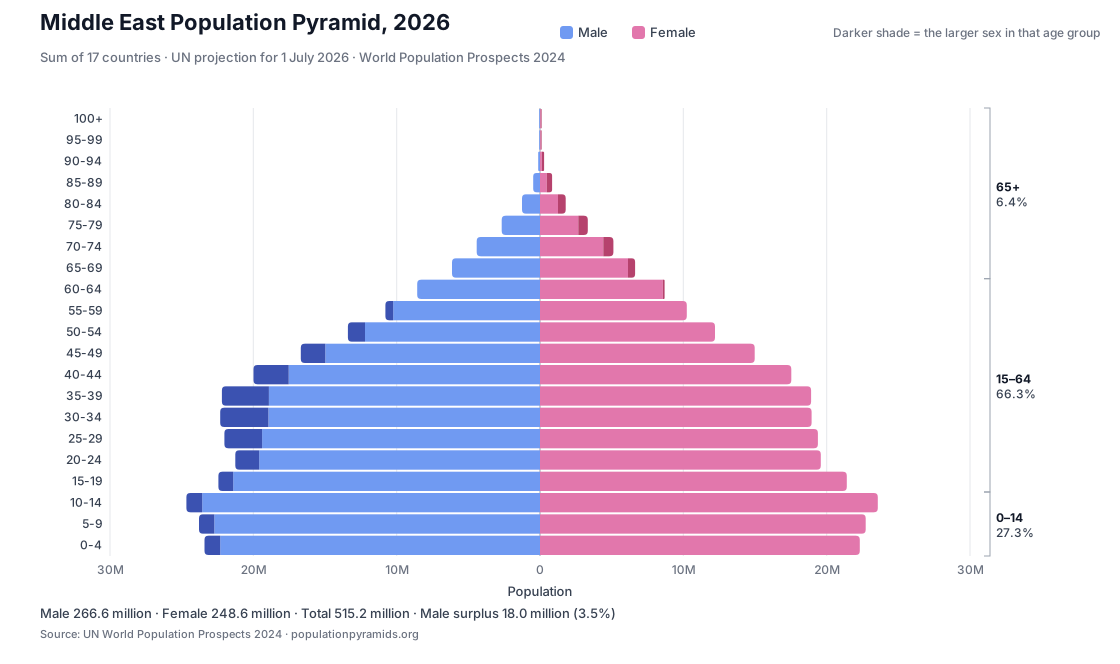
The 17 countries of the Middle East have 515.2 million people in the UN projection for 2026, 1.43% more than a year earlier. Egypt (120.1 million), Iran (93.2 million) and Turkey (87.9 million) hold 58% of them. The region's population pyramid has 18.0 million more men than women, 16.8 million of them aged 20 to 59. Below: every country by population, which countries count as the Middle East, growth to 2100 and the region's demographics.
Data: UN World Population Prospects 2024, projections for 1 July 2026 (medium variant), added up for the 17 countries.
Middle East population pyramid

Show the numbers
| Age group | Male | Female | Total | Share |
|---|---|---|---|---|
| 100+ | 1,883 | 7,408 | 9,291 | 0.00% |
| 95-99 | 19,040 | 61,589 | 80,629 | 0.02% |
| 90-94 | 128,157 | 289,126 | 417,283 | 0.08% |
| 85-89 | 477,224 | 845,904 | 1,323,128 | 0.26% |
| 80-84 | 1,253,334 | 1,795,889 | 3,049,223 | 0.59% |
| 75-79 | 2,672,906 | 3,335,657 | 6,008,563 | 1.17% |
| 70-74 | 4,413,624 | 5,118,154 | 9,531,778 | 1.85% |
| 65-69 | 6,141,287 | 6,634,427 | 12,775,714 | 2.48% |
| 60-64 | 8,570,149 | 8,691,201 | 17,261,350 | 3.35% |
| 55-59 | 10,788,897 | 10,243,962 | 21,032,859 | 4.08% |
| 50-54 | 13,403,921 | 12,210,894 | 25,614,815 | 4.97% |
| 45-49 | 16,688,790 | 14,980,037 | 31,668,827 | 6.15% |
| 40-44 | 19,988,167 | 17,532,683 | 37,520,850 | 7.28% |
| 35-39 | 22,190,906 | 18,911,098 | 41,102,004 | 7.98% |
| 30-34 | 22,310,242 | 18,951,217 | 41,261,459 | 8.01% |
| 25-29 | 22,016,978 | 19,387,861 | 41,404,839 | 8.04% |
| 20-24 | 21,260,609 | 19,591,996 | 40,852,605 | 7.93% |
| 15-19 | 22,438,024 | 21,401,389 | 43,839,413 | 8.51% |
| 10-14 | 24,667,207 | 23,564,100 | 48,231,307 | 9.36% |
| 5-9 | 23,788,919 | 22,719,847 | 46,508,766 | 9.03% |
| 0-4 | 23,406,618 | 22,309,693 | 45,716,311 | 8.87% |
| Total | 266,626,882 | 248,584,132 | 515,211,014 | 100.00% |
| Male surplus 18,042,750 (3.5% of the population). Source: UN World Population Prospects 2024, five-year age groups, projection for 1 July 2026. | ||||
By the rule this site applies to every country, the combined pyramid is stationary: 27.3% of people are under 15, between Africa's 38.4% and Europe's 14.8%. The bulge on the men's side from age 20 to 59 is mostly in the six Gulf states. The UN publishes no median age for this group of countries, so the image has no median line.
Source: UN World Population Prospects 2024, five-year age groups by sex for the 17 countries, projection for 1 July 2026, added up by this site.
Middle East countries by population
The 17 countries ranked by population, 2026 (UN projection).
| # | Country | Population | Share | Growth rate | Median age | Fertility rate |
|---|---|---|---|---|---|---|
| 1 | Egypt | 120,101,176 | 23.3% | 1.47% | 24.7 | 2.68 |
| 2 | Iran | 93,168,497 | 18.1% | 0.81% | 34.5 | 1.66 |
| 3 | Turkey | 87,926,082 | 17.1% | 0.27% | 33.9 | 1.62 |
| 4 | Iraq | 48,007,437 | 9.3% | 2.10% | 21.1 | 3.13 |
| 5 | Yemen | 42,961,653 | 8.3% | 2.84% | 18.5 | 4.33 |
| 6 | Saudi Arabia | 35,165,787 | 6.8% | 1.73% | 29.7 | 2.27 |
| 7 | Syria | 26,472,497 | 5.1% | 3.33% | 23.8 | 2.62 |
| 8 | Jordan | 11,589,532 | 2.2% | 0.60% | 24.9 | 2.54 |
| 9 | United Arab Emirates | 11,574,683 | 2.2% | 2.02% | 31.6 | 1.21 |
| 10 | Israel | 9,647,689 | 1.9% | 1.37% | 29.3 | 2.73 |
| 11 | Lebanon | 5,897,466 | 1.1% | 0.82% | 29.0 | 2.19 |
| 12 | Palestine | 5,692,790 | 1.1% | 1.85% | 20.3 | 3.13 |
| 13 | Oman | 5,671,458 | 1.1% | 3.22% | 29.8 | 2.44 |
| 14 | Kuwait | 5,102,773 | 1.0% | 1.53% | 34.8 | 1.49 |
| 15 | Qatar | 3,173,560 | 0.6% | 1.85% | 33.4 | 1.69 |
| 16 | Bahrain | 1,675,572 | 0.3% | 1.96% | 33.4 | 1.77 |
| 17 | Cyprus | 1,382,334 | 0.3% | 0.84% | 39.1 | 1.37 |
| Middle East (17 countries) | 515,210,986 | 100.0% | 1.43% |
 Egypt
 Iran
 Turkey
 Iraq
 Yemen
 Saudi Arabia
 Syria
 Jordan
 United Arab Emirates
 Israel
 Lebanon
 Palestine
 Oman
 Kuwait
 Qatar
 Bahrain
 Cyprus
Population on 1 July 2026; growth rate = the change in population from 1 July 2025 to 1 July 2026, as on the growth rate page; fertility rate = children per woman. Source: UN World Population Prospects 2024, medium-variant projections. Each country's pyramid is on its own page.
Which countries are in the Middle East
There is no official list. Encyclopaedia Britannica lists the countries virtually every definition includes: the seven of the Arabian Peninsula (Saudi Arabia, Kuwait, Yemen, Oman, Bahrain, Qatar and the United Arab Emirates), the Levant (Syria, Lebanon, Israel, Jordan and Palestine) and Iraq. Egypt, Iran and Turkey are typically included, and Cyprus sometimes. This page counts all 17.
Those 13 countries have 212.6 million people in 2026. With Egypt, Iran and Turkey the total is 513.8 million, and with Cyprus 515.2 million. Wider uses of the term take in North Africa and sometimes Afghanistan, Pakistan or Central Asia; this page leaves those out.
The UN, whose figures this site uses, has no Middle East region. Its nearest region, Western Asia, has 319.1 million people in 2026: it adds Azerbaijan, Georgia and Armenia and leaves out Egypt and Iran.
Sources: Encyclopaedia Britannica, “Middle East” (Terminology and meaning); UN World Population Prospects 2024, country and Western Asia totals, projection for 2026; UN M49 regions.
Middle East population growth
The 17 countries had 79.6 million people in 1950. They have 515.2 million in 2026, and the UN projects 665.4 million by 2050 and 791.9 million by 2100, still growing at the end of the projection. In 2026 the region records 9.4 million births and 2.5 million deaths, and gains 0.5 million people through migration. Syria (3.33%), Oman (3.22%) and Yemen (2.84%) grow fastest; Turkey grows slowest, at 0.27%. Growth rates for every country are on the population growth rate by country page.
Source: UN World Population Prospects 2024, population on 1 July, births, deaths and net migration for each of the 17 countries (estimates to 2023, medium-variant projections from 2024), added up by this site.
Middle East demographics
Men outnumber women most in the six Gulf states, which account for about 14.7 million of the region's 18.0 million extra men. All six gain people through migration in 2026, from 3.1 to 14.1 per 1,000 people a year.
- 1.Qatar243.7
- 2.United Arab Emirates175.0
- 3.Oman166.5
- 4.Bahrain163.2
- 5.Kuwait156.5
- 6.Saudi Arabia152.0
Fertility runs from 1.21 children per woman in the United Arab Emirates to 4.33 in Yemen, and median age from 18.5 in Yemen to 39.1 in Cyprus. Across the region, 6.4% of people are 65 or older; the UN projects them to outnumber children under 15 from 2076. Sex ratios for every country are on the male to female ratio page.
Source: UN World Population Prospects 2024, sex ratio, net migration rate, fertility and median age by country, projection for 2026 (medium variant); the Gulf share of the male surplus is worked out from each country's population and sex ratio.
Frequently asked questions
Figures: UN World Population Prospects 2024, projections for 2026 to 2100, added up for the 17 countries where noted.
What is the population of the Middle East?
515.2 million in the UN's 2026 projection, counting the 17 countries on this page. The 13 countries that virtually every definition includes have 212.6 million; with Egypt, Iran and Turkey, which are typically included, the total is 513.8 million.
Which is the most populous country in the Middle East?
Egypt, with 120.1 million people in the UN's 2026 projection, followed by Iran (93.2 million) and Turkey (87.9 million). The smallest is Cyprus, with 1.4 million.
Which countries are in the Middle East?
Definitions vary. Encyclopaedia Britannica lists the countries virtually every definition includes: the seven of the Arabian Peninsula (Saudi Arabia, Kuwait, Yemen, Oman, Bahrain, Qatar and the United Arab Emirates), the Levant (Syria, Lebanon, Israel, Jordan and Palestine) and Iraq. Egypt, Iran and Turkey are typically included, and Cyprus sometimes. This page counts all 17.
How fast is the Middle East's population growing?
By 1.43% from 2025 to 2026, in the UN's projections for the 17 countries. The UN projects 665.4 million by 2050 and 791.9 million by 2100.
Why are there more men than women in the Gulf states?
The extra men are of working age, and all six Gulf states gain people through migration. In the UN's 2026 projection Qatar has 243.7 males for every 100 females and the United Arab Emirates 175.0; in the other 11 countries it runs from 94.8 to 106.0.
Is the Middle East the same as Western Asia?
No. Western Asia is a UN region of 18 countries with 319.1 million people in 2026. It includes Azerbaijan, Georgia and Armenia, and it leaves out Egypt and Iran, which Britannica says are typically counted in the Middle East.
Population pyramids of other regions: Africa and Europe. Every country has its own page, listed on countries by population.
Related demographic tools & calculators
- Population Projection 2050 & 2100UN-projected population for any country, any year through 2100, plus peak-year info
- Life Expectancy by CountryLife expectancy at birth for 194 countries, 1950–2100
- Infant Mortality Rate by CountryDeaths before age 1 per 1,000 live births, 194 countries
- Death Rate by CountryDeaths per 1,000 people, 194 countries, and why older countries rank higher
- US Birth RateUS births and birth rates by year, state and race (CDC)
- World Birth RateWorld births per day, birth and death rates, 1950–2100
- Replacement-Level FertilityWhy 2.1, and each country's own replacement level
- Fertility Rate by CountryFertility and birth rates per country, below-replacement tracker
- Population Density by CountryMost & least crowded countries + "what if" comparisons
- Population When You Were BornWorld population in your birth year vs 2026
- Population Pyramid MakerGenerate custom pyramids from country or your data · PNG/SVG
- What Generation Am I?Gen Z, Millennial, Boomer ranges + 194 country breakdowns
- Median Age by CountryWorld's oldest & youngest populations
- Dependency Ratio CalculatorYouth + elderly per 100 working-age adults
- Male to Female RatioGender ratio per country, age band, and globally
Sources
UN World Population Prospects 2024: population, population by five-year age group and sex, births, deaths, net migration, growth rate, fertility, median age and sex ratio for each of the 17 countries and for Western Asia, with estimates for 1950–2023 and medium-variant projections from 2024; the regional totals are this site's sums of the country figures. Encyclopaedia Britannica, “Middle East”: which countries virtually every definition of the Middle East includes, and which it typically or sometimes includes.