Africa Population Pyramid, 2026
By Marko Visic · Updated
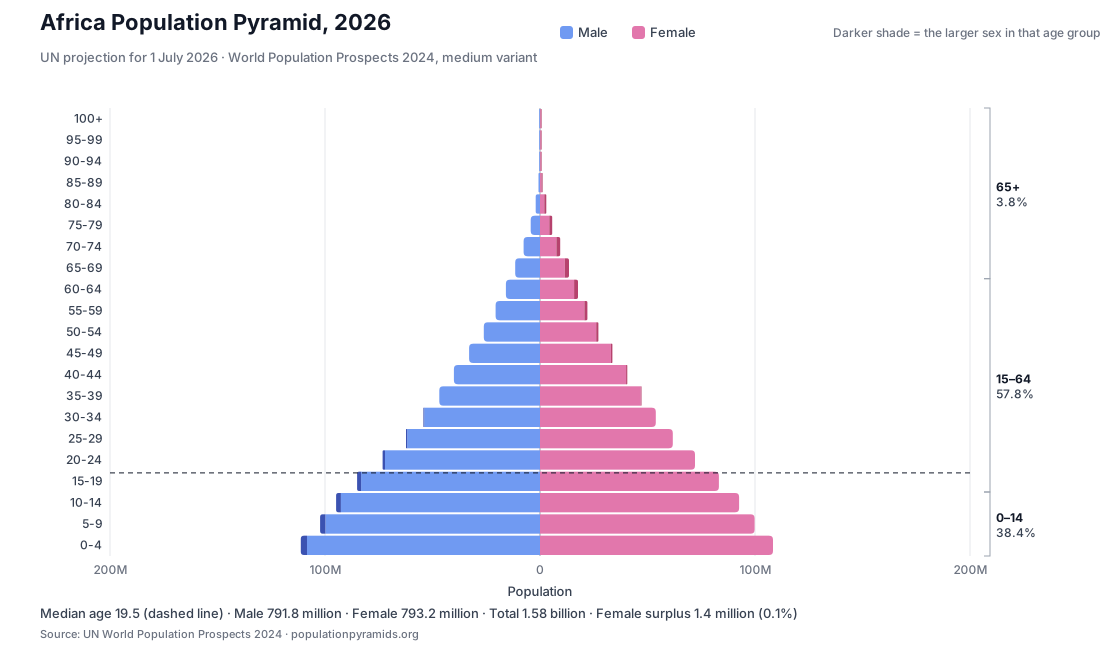
Africa has 1.58 billion people in the UN projection for 2026, and its population pyramid is wide at the base: 38.4% are under 15 and 3.8% are 65 or older, with a median age of 19.5. The population grows 2.27% a year, faster than any other world region, and the UN projects 2.47 billion by 2050 and 3.81 billion by 2100. Below: the pyramid, Africa's growth and birth rates country by country, and sub-Saharan Africa.
Data: UN World Population Prospects 2024, a projection for 1 July 2026 (medium variant).
Africa's population pyramid

Show the numbers
| Age group | Male | Female | Total | Share |
|---|---|---|---|---|
| 100+ | 3,805 | 11,632 | 15,437 | 0.00% |
| 95-99 | 29,422 | 78,769 | 108,191 | 0.01% |
| 90-94 | 176,679 | 380,459 | 557,138 | 0.04% |
| 85-89 | 720,254 | 1,227,219 | 1,947,473 | 0.12% |
| 80-84 | 2,001,515 | 2,916,340 | 4,917,855 | 0.31% |
| 75-79 | 4,323,218 | 5,673,712 | 9,996,930 | 0.63% |
| 70-74 | 7,649,924 | 9,395,775 | 17,045,699 | 1.08% |
| 65-69 | 11,529,632 | 13,466,490 | 24,996,122 | 1.58% |
| 60-64 | 15,856,580 | 17,653,447 | 33,510,027 | 2.11% |
| 55-59 | 20,645,571 | 22,023,914 | 42,669,485 | 2.69% |
| 50-54 | 26,139,250 | 27,150,892 | 53,290,142 | 3.36% |
| 45-49 | 32,995,302 | 33,664,914 | 66,660,216 | 4.21% |
| 40-44 | 40,038,212 | 40,608,774 | 80,646,986 | 5.09% |
| 35-39 | 46,833,394 | 47,207,045 | 94,040,439 | 5.93% |
| 30-34 | 53,879,925 | 53,850,781 | 107,730,706 | 6.80% |
| 25-29 | 62,307,290 | 61,754,484 | 124,061,774 | 7.83% |
| 20-24 | 73,225,613 | 72,082,204 | 145,307,817 | 9.17% |
| 15-19 | 85,082,008 | 83,223,084 | 168,305,092 | 10.62% |
| 10-14 | 94,831,326 | 92,613,484 | 187,444,810 | 11.83% |
| 5-9 | 102,272,281 | 99,833,285 | 202,105,566 | 12.75% |
| 0-4 | 111,241,227 | 108,386,123 | 219,627,350 | 13.86% |
| Total | 791,782,428 | 793,202,827 | 1,584,985,255 | 100.00% |
| Female surplus 1,420,399 (0.1% of the population). Source: UN World Population Prospects 2024, five-year age groups, projection for 1 July 2026. | ||||
By the rule this site applies to every country, Africa's pyramid is expansive: the youngest age group, children under five, is the largest. Half of all Africans are younger than 19.5; the UN projects the under-15 share to fall from 38.4% today to 20.7% by 2100 as birth rates come down.
Source: UN World Population Prospects 2024, the UN region Africa, five-year age groups, projection for 1 July 2026 and projections to 2100.
Africa population growth
Africa had 227.8 million people in 1950, 9.1% of the world. It has 1.58 billion in 2026 (19.1%), and the UN projects 3.81 billion by 2100, which would be 37.5% of the world's people. Its growth of 2.27% from 2025 to 2026 is the highest of the six world regions; the next is Oceania, at 1.09%. Only one African country is shrinking: Mauritius (−0.25%).
- 1.Central African Republic3.37%
- 2.Somalia3.31%
- 3.Niger3.21%
- 4.Democratic Republic of the Congo3.21%
- 5.Sudan3.14%
- 6.Angola3.01%
- 7.Mali2.91%
- 8.Tanzania2.86%
- 9.Mozambique2.83%
- 10.Zambia2.77%
 Central African Republic
 Somalia
 Niger
 Democratic Republic of the Congo
 Sudan
 Angola
 Mali
 Tanzania
 Mozambique
 Zambia
Growth rates for every country, African countries included, are on the population growth rate by country page.
Source: UN World Population Prospects 2024, the UN's own total for Africa (estimates to 2023, medium-variant projections from 2024) and each country's population on 1 July 2025 and 1 July 2026; growth is the change between the two.
African birth rate
Africa's birth rate is 30.0 per 1,000 people in the UN's 2026 projection, against 16.0 for the world, and women have 3.89 children on average. In 1950 the birth rate was 47.8 and the death rate 26.9; deaths have fallen much faster than births, which is why the population grows so fast.
- 1.Central African Republic44.7
- 2.Chad42.2
- 3.Somalia41.2
- 4.Niger40.2
- 5.Democratic Republic of the Congo39.8
- 6.Mali38.8
- 7.Angola36.3
- 8.Mozambique36.1
- 9.Tanzania33.9
- 10.Mauritania33.2
 Chad
 Mauritania
- 1.Mauritius8.9
- 2.Cabo Verde12.0
- 3.Tunisia12.6
- 4.Seychelles13.2
- 5.Libya15.8
- 6.Morocco15.8
- 7.Algeria17.3
- 8.South Africa17.8
- 9.Djibouti20.4
- 10.Egypt20.5
 Mauritius
 Cabo Verde
 Tunisia
 Seychelles
 Libya
 Morocco
 Algeria
 South Africa
 Djibouti
 Egypt
Every country's birth rate is on the birth rate by country page.
Source: UN World Population Prospects 2024, projection for 2026 (medium variant). Rates for 1950 to 2023 are UN estimates.
Population growth in sub-Saharan Africa
Sub-Saharan Africa, the UN's grouping of every African country outside Northern Africa, has 1.30 billion people in 2026 and grows 2.41% a year, with a fertility rate of 4.11 and a median age of 18.5. The UN projects 3.35 billion there by 2100. Northern Africa, with 280.7 million, grows 1.61% a year. Middle Africa has the highest fertility of the five subregions (5.28).
| UN subregion | Population 2026 | Growth rate | Fertility rate | Median age | Population 2050 | Population 2100 |
|---|---|---|---|---|---|---|
| Northern Africa | 280.7 million | 1.61% | 2.85 | 25.1 | 373.0 million | 462.4 million |
| Western Africa | 476.9 million | 2.22% | 4.19 | 18.4 | 734.8 million | 1.07 billion |
| Eastern Africa | 526.4 million | 2.51% | 3.89 | 18.5 | 855.5 million | 1.38 billion |
| Middle Africa | 226.1 million | 2.99% | 5.28 | 16.5 | 411.7 million | 790.4 million |
| Southern Africa | 74.9 million | 1.14% | 2.25 | 28.1 | 91.6 million | 108.6 million |
| Sub-Saharan Africa | 1.30 billion | 2.41% | 4.11 | 18.5 | 2.09 billion | 3.35 billion |
Source: UN World Population Prospects 2024, the UN's own totals for its African subregions and the SDG region Sub-Saharan Africa: projections for 2026, 2050 and 2100 (medium variant). Growth rate = the change in population from 1 July 2025 to 1 July 2026. The UN totals include territories that are not among this site's countries.
Frequently asked questions
Figures: UN World Population Prospects 2024, projections for 2026 to 2100 and estimates for 1950.
What is the population of Africa in 2026?
1.58 billion in the UN's 2026 projection, 19.1% of the world's people. In 1950 Africa had 227.8 million, 9.1% of the world.
How fast is Africa's population growing?
2.27% from 1 July 2025 to 1 July 2026 in the UN's projections, the fastest of the six world regions and more than twice the world's 0.84%. Births outnumber deaths by about four to one: 30.0 against 7.5 per 1,000 people.
What will the population of Africa be in 2050 and 2100?
The UN projects 2.47 billion in 2050 and 3.81 billion in 2100, when Africa would hold 37.5% of the world's people. Its population is still growing at the end of the projection.
What type of population pyramid does Africa have?
An expansive one, by the rule this site uses for every country: 38.4% of Africans are under 15 and the youngest age group is the largest. The median age is 19.5.
Which African country has the highest birth rate?
The Central African Republic, with 44.7 births per 1,000 people in the UN's 2026 projection, followed by Chad, Somalia and Niger. The lowest is Mauritius, at 8.9.
Is Africa overpopulated?
By density, Africa is less crowded than the world as a whole: 53.6 people per square kilometer in 2026, against 63.7 for the world and 155.1 for Asia. What sets it apart is growth: the UN projects 3.81 billion people by 2100, 2.4 times today's number.
Population pyramids of other regions: Europe and Middle East. Every country has its own page, listed on countries by population.
Related demographic tools & calculators
- Population Projection 2050 & 2100UN-projected population for any country, any year through 2100, plus peak-year info
- Life Expectancy by CountryLife expectancy at birth for 194 countries, 1950–2100
- Infant Mortality Rate by CountryDeaths before age 1 per 1,000 live births, 194 countries
- Death Rate by CountryDeaths per 1,000 people, 194 countries, and why older countries rank higher
- US Birth RateUS births and birth rates by year, state and race (CDC)
- World Birth RateWorld births per day, birth and death rates, 1950–2100
- Replacement-Level FertilityWhy 2.1, and each country's own replacement level
- Fertility Rate by CountryFertility and birth rates per country, below-replacement tracker
- Population Density by CountryMost & least crowded countries + "what if" comparisons
- Population When You Were BornWorld population in your birth year vs 2026
- Population Pyramid MakerGenerate custom pyramids from country or your data · PNG/SVG
- What Generation Am I?Gen Z, Millennial, Boomer ranges + 194 country breakdowns
- Median Age by CountryWorld's oldest & youngest populations
- Dependency Ratio CalculatorYouth + elderly per 100 working-age adults
- Male to Female RatioGender ratio per country, age band, and globally
Sources
UN World Population Prospects 2024: population by five-year age group and sex, growth rate, births, deaths, fertility, median age and population density for Africa, its subregions, Sub-Saharan Africa and its countries, with estimates for 1950–2023 and medium-variant projections from 2024. The pyramid image and charts are drawn from these figures.